University Mound Reservoir
Reservoir
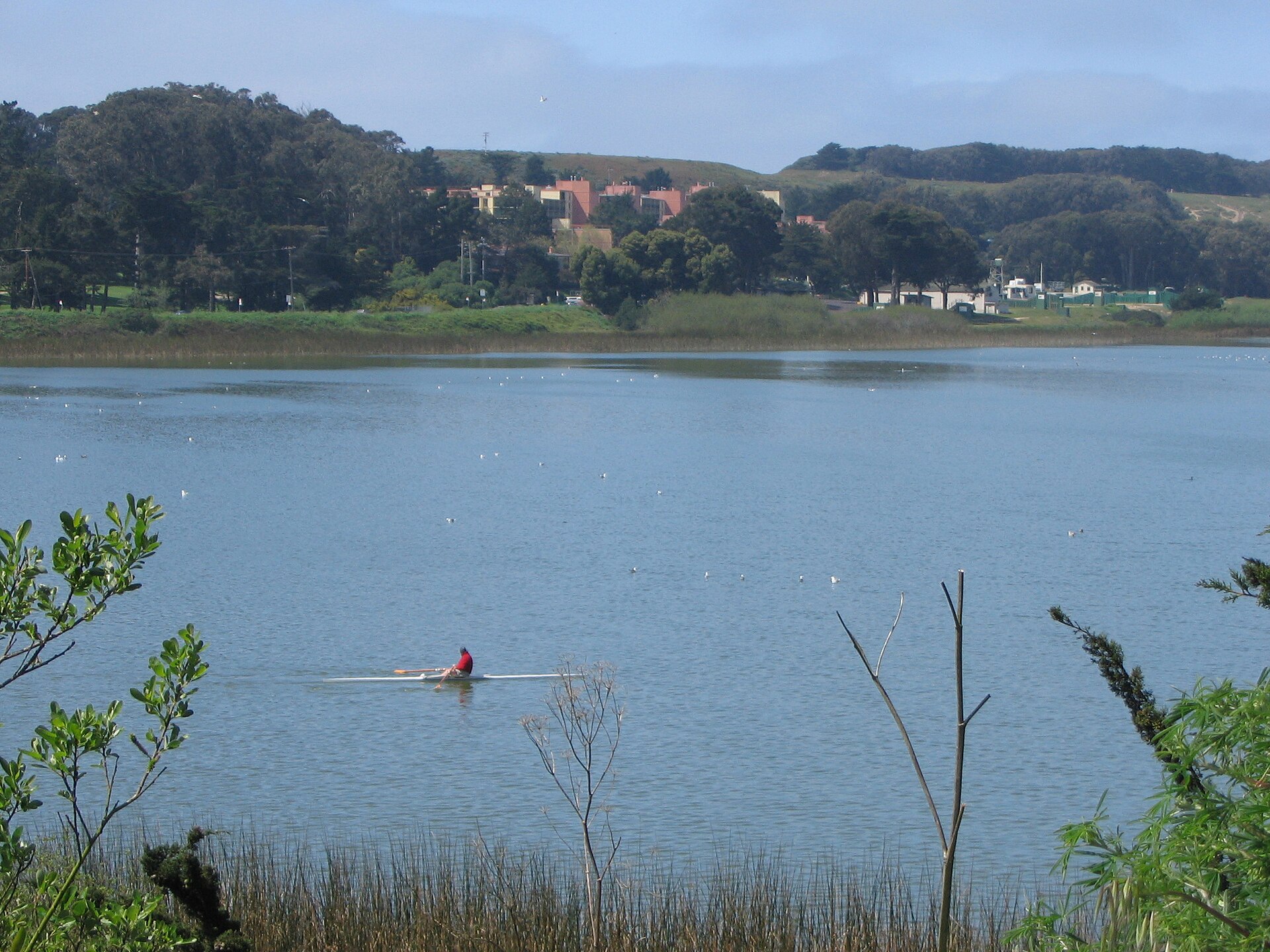
University Mound Reservoir (reservoir, run by the Public Utilities Commission): $1.8B budgeted for its department in FY2025, 2,679 employees on the payroll, 5 city documents at the Internet Archive, every figure linked to its source. University Mound is the reservoir the flat half of San Francisco drinks from. A 1935 account of the city's water and power describes it at elevation 172 feet with a capacity of 60 million gallons, supplying the lowest pressure zone — the waterfront, the industrial areas and the major business district — which together used about 40 percent of all the water consumed in the city; the water reached it from Crystal Springs through a 44-inch riveted wrought-iron pipeline seventeen miles long, built in 1885. Its enlargement was public works money: the Public Utilities Commission's report on the 1933 bond issue lists both the University Mound Reservoir Addition and a second Crystal Springs-University Mound pipeline among the contracts let under Public Works Administration Docket 1510, illustrated with construction views. The reservoir also has a cameo in one of the city's great legal fights — in the Spring Valley Water Company's suit against the city, an engineer's appraisal of the municipal reservoirs works its excavation out at 40 cents a yard and compacted fill at 25, and concludes flatly that "the University Mound Reservoir, in my opinion, is a steam shovel job". The health department was sampling its water at the intake, six feet below the surface, by 1908. A century later a regional reliability study still describes the city's distribution in two halves: the west side served from Sunset Reservoir, the east side from here. Source: SF Controller open data and the Internet Archive.
 i.ytimg.com · Bing · UNVERIFIED
University Mound is the reservoir the flat half of San Francisco drinks from. A 1935 account of the city's water and power describes it at elevation 172 feet with a capacity of 60 million gallons, supplying the lowest pressure zone — the waterfront, the industrial areas and the major business district — which together used about 40 percent of all the water consumed in the city; the water reached it from Crystal Springs through a 44-inch riveted wrought-iron pipeline seventeen miles long, built in 1885. Its enlargement was public works money: the Public Utilities Commission's report on the 1933 bond issue lists both the University Mound Reservoir Addition and a second Crystal Springs-University Mound pipeline among the contracts let under Public Works Administration Docket 1510, illustrated with construction views. The reservoir also has a cameo in one of the city's great legal fights — in the Spring Valley Water Company's suit against the city, an engineer's appraisal of the municipal reservoirs works its excavation out at 40 cents a yard and compacted fill at 25, and concludes flatly that "the University Mound Reservoir, in my opinion, is a steam shovel job". The health department was sampling its water at the intake, six feet below the surface, by 1908. A century later a regional reliability study still describes the city's distribution in two halves: the west side served from Sunset Reservoir, the east side from here.
No city spending is recorded against this place by name. San Francisco publishes contracts, bond items and vendor payments at project level, and none of them names this site — so there is no figure to show, rather than a figure of zero.
Run by the Public Utilities Commission (water, power, sewer), whose whole-department budget is $1.8B across 2,679 staff (FY2025) — citywide, not this place’s own. The City does not publish a running cost per building.
A commission report listing the reservoir's addition among contracts let under the 1933 bond issue.
Report of the San Francisco Public Utilities Commission · 1933 ↗Internet Archive — San Francisco Public Library partnership scansA 1935 account giving the reservoir's capacity, elevation, and the pressure zone it supplies.
San Francisco water and power · 1935 ↗Internet Archive — San Francisco Public Library partnership scansTestimony from the Spring Valley water litigation appraising the reservoir's excavation cost per yard.
Spring Valley Water Company, plaintiff, vs. City and County of San Francisco, et al., defendants. Nos. 14,735; 14,892; 15,131; 15,344; 15,569, Circuit Court of U.S., Ninth Judicial Circuit, Northern District of California, and 26 and 96 District Court of U.S., Northern District of California, second division. Abstract of testimony [and oral arguments] taken before Honorable H.M. Wright · 1916 ↗Internet Archive — San Francisco Public Library partnership scansA regional reliability study describing the city's east-side pressure zones served from this reservoir.
Facilities reliability program : phase II : regional system overview · 2000 ↗Internet Archive — San Francisco Public Library partnership scans
1 procedural record — minutes, agendas, calendars — not listed.